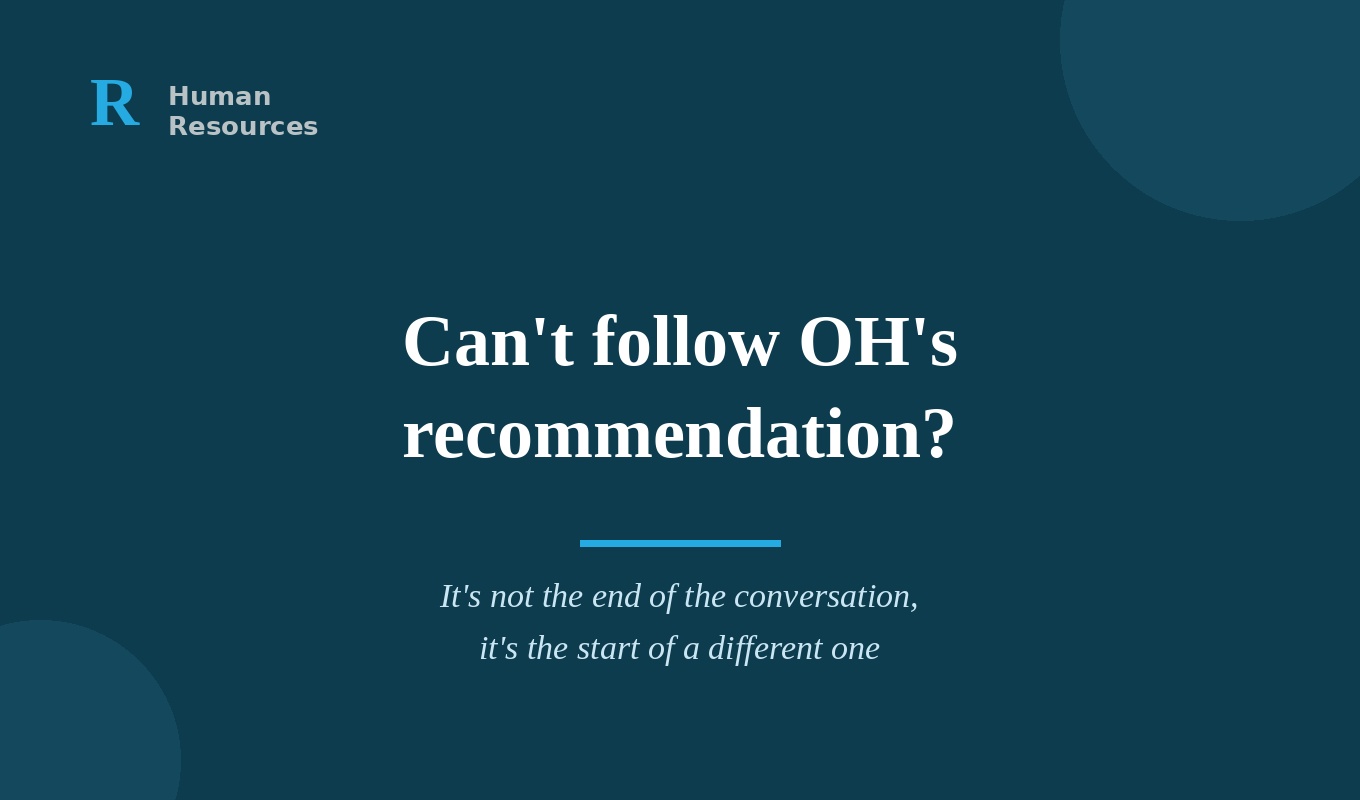
This is the conversation I’ve had with a client this week and it comes up more often than you might think.
For example, Occupational Health recommends that an employee works from home two days a week. On paper, that sounds reasonable. But what if the role involves covering multiple sites, managing a team, and being physically present to deliver the service?
You can’t simply say, “We can’t do that.”
But equally, the employee shouldn’t be left feeling that their needs, health or circumstances aren’t being taken seriously.
So, what do you do?
Here’s what I tell clients:
🔹 “We can’t accommodate this” isn’t the end of the conversation, it’s the start of a different one.
🔹 Go back to Occupational Health and ask: given the operational constraints, what else might help?
🔹 Explore genuine alternatives — different hours, adjustments to duties, a different role, a partial version of the recommendation, or other practical support.
🔹 Consider whether Access to Work may be able to provide additional support or funding to help the employee stay in work.
🔹 Most importantly, talk to the employee. Ask what would make the biggest difference to them and involve them in finding a workable solution.
🔹 Be open about the things you genuinely can’t change, but also be clear about what you can do.
🔹 Document your reasoning in the context of that particular role, rather than relying on a generic policy statement.
Ultimately, you should be able to answer two questions:
“Have we genuinely tried to support this employee?”
And:
“Have we properly considered what is reasonably workable within this particular role?”
Because this shouldn’t be about choosing between supporting the employee and running the business effectively.
It’s about having an honest, respectful conversation and finding the best solution you reasonably can.
These situations can be incredibly sensitive and challenging for everyone involved. If you find yourself dealing with this, please take appropriate HR advice.
What happens when Occupational Health recommends something you genuinely can’t do?